

The Clock is Running
If you read the email that brought you here, you already know the punchline. My friend, Rob Kistenberg, from Georgia Tech, just published the first study of its kind — tracking what actually happens with O&P graduates over the first 5 to 20 years of their careers. The big takeaway for me is this: those clinician’s who decide to leave clinical care, do so on average, in 5.5 years.
Five and a half years. Wow. That's right about the time they've stopped asking where things are kept and started being the person others ask. While the headline may seem fatalistic, what's good about this is the fact that it's predictable...and from my background in business management, I know that with a predictable problem, you can do something about it. So before I share the data with you, I'd like you to explore practical ways you can use the research implications as a tool to help your practice be the exception.
In my blog on June 20, 2024 I introduced the concept of a “Stay Interview.” This study drives home the need for having conversations early. At year two and again at year four, sit down with each clinician on your team — not a performance review, just a real conversation. Ask: "What would make this the right place to be in three years?" You'll learn things you wouldn't otherwise know until an exit interview makes it too late. Our goal should be to create an environment that reinforces the positive attributes of the job. You want to know what drives each person, specifically. The data shows clinicians leave for very different reasons. What keeps a clinician who loves complex cases is not what keeps someone drawn to teaching or industry. A blanket retention strategy works for no one in particular.
Cut the administrative load wherever you can. Research consistently ties documentation burden and EHR friction to clinician frustration and eventual departure. If your team is spending time on tasks that could be streamlined, that's not just an efficiency problem — it has a dollar figure attached to it.
Use what you learn in those stay interviews to fix what's fixable — lighter workload, clearer expectations, less friction day to day. Then take what you can't fix through culture and conversation and build it into your systems instead. If your workflows, payer rules, documentation habits, and patient processes only exist in someone's head, they leave with that person. Every. Single. Time. That's not a staffing problem — it's a structural one, and it's fixable.
OPIE Anywhere gives you the tools to make this real. One of the most underused capabilities in OPIE 2.0 is configurable workflow design — the ability to build your practice's actual processes directly into the system, from intake through billing and follow-up. When your workflows are intentional and built in, two things happen: new staff onboard to a system that runs the way you run and departing staff don't take tribal knowledge out the door with them. If you haven't mapped your workflows and built them deliberately, put it on the calendar.
What the Data Shows
Robert S. Kistenberg, MPH, CP, LP, FAAOP of Georgia Tech tracked 166 graduates of Georgia Tech's O&P Master's program, tracing their careers 5 to 20 years post-graduation and recording where they landed on May 1, 2024. His study — the first of its kind anywhere in the world — was published in Prosthetics and Orthotics International in 2026.
The big picture:
90% of graduates attained national certification
69% were still in clinical practice 5–20 years later
11% stayed in O&P but moved to nonclinical roles — education, research, industry
20% left O&P and health care entirely
Average time in clinical practice before a change: 5.5 years
Annual early-to-mid-career attrition rate: 2.66%
But the quartile breakdown is where it gets real:
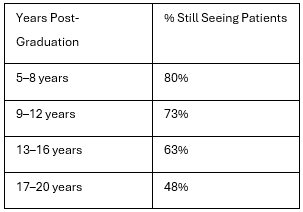
By the time your clinician has 17–20 years under their belt, there's less than a coin-flip chance they're still in direct clinical practice. Kistenberg himself calls a benchmark of only 80% of graduates remaining clinically active within 5 to 20 years "low if a profession is going to sustain its capacity to meet the demands of their patients."
Where They Go — and What It Tells You
The study introduces a new metric — Clinical Practitioner Timespan (CPT) — the time from certification until a clinician leaves direct patient care. The overall average is 5.5 years, but the breakdown by destination tells a more useful story:
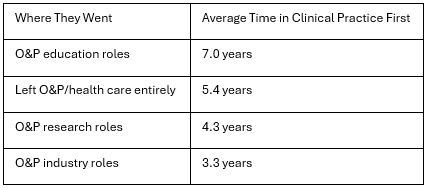
The clinicians who left for industry left the fastest — averaging just 3.3 years before making the move. If you have someone on your team who's deeply engaged with vendors, developing a specialty niche, or asking a lot of questions about the business side of things — that's not a red flag, but it's worth a conversation.
The ones who went into education stayed the longest — 7 years on average — and brought genuine clinical depth with them. These aren't people who burned out. They're people who wanted more, found a path, and took it.
The Cost — In Real Numbers
A 2.66% annual attrition rate sounds small. In a 4-person clinical team, it's roughly a 1-in-10 chance of losing someone in any given year. Over five years, that compounds. And when it happens, the math is a bit more sobering.
Research on advanced practice provider turnover puts the direct cost of a single clinical departure at $85,000 to $115,000 — before you factor in lost productivity, patient disruption, or what it does to the people who stay. A vacant clinician position can mean $30,000 in unbillable appointments over just three months.i
And you're recruiting into a tightening market. BLS projects O&P employment to grow 13% from 2024 to 2034, with roughly 900 openings a year nationally. NCOPE has flagged that attrition rates are likely to outpace the growth in new certified providers if the education pipeline doesn't expand. Every clinician you retain is one for which you are not competing.
The 11% You're Probably Not Thinking About
Eighteen of the 166 graduates in this cohort didn't leave O&P — they just moved out of the clinic. They went into education, research, or industry. Their average time in clinical practice before that move? 7 years for those who became educators.
These people left because they wanted more room to grow and the clinic couldn't offer it. In a small practice, the org chart is flat. There's often nowhere for that ambition to go. But sometimes a clinical education role, a mentorship function for residents or students, or a quality improvement lead title — it doesn't have to be elaborate — is exactly the thing that keeps a great clinician from looking elsewhere for the growth they're craving. Maybe your new hire with leanings toward education would be a great residency director.
Back to That New Hire
This study doesn't describe a profession in crisis. But it does confirm that O&P attrition is real, measurable, and patterned — and for the first time, we have data to back that up.
Remember that ‘all star’ you just hired? The one you're picturing right now? They want to stay. Most people do. The practices that hold onto good clinicians longest aren't necessarily the ones paying the most — they're the ones where someone is paying attention. Where the conversation happens before the decision is already made. Where there's room to grow, and the work doesn't crush the person doing it.
That's not a systems problem. It's a leadership habit. And it starts earlier than you think.